
Introduction
Welcome to our travel diaries, a new blog where our first episode shines a light on Siargao in the Philippines aka the island of mangroves! Here you will get an authentic opinionated view of our recent trip with key topics discussed. We aren’t funded by tour/insurance companies or anyone else unlike other travel blogs so you will get an unbiased account of our experience!
Siargao – what a place; abundant vegetation, stunning palm trees, rivers, cascading waterfalls and… fees. Yup, unlike other islands in the Philippines fees seem to exist for everything here as you will go on to read.
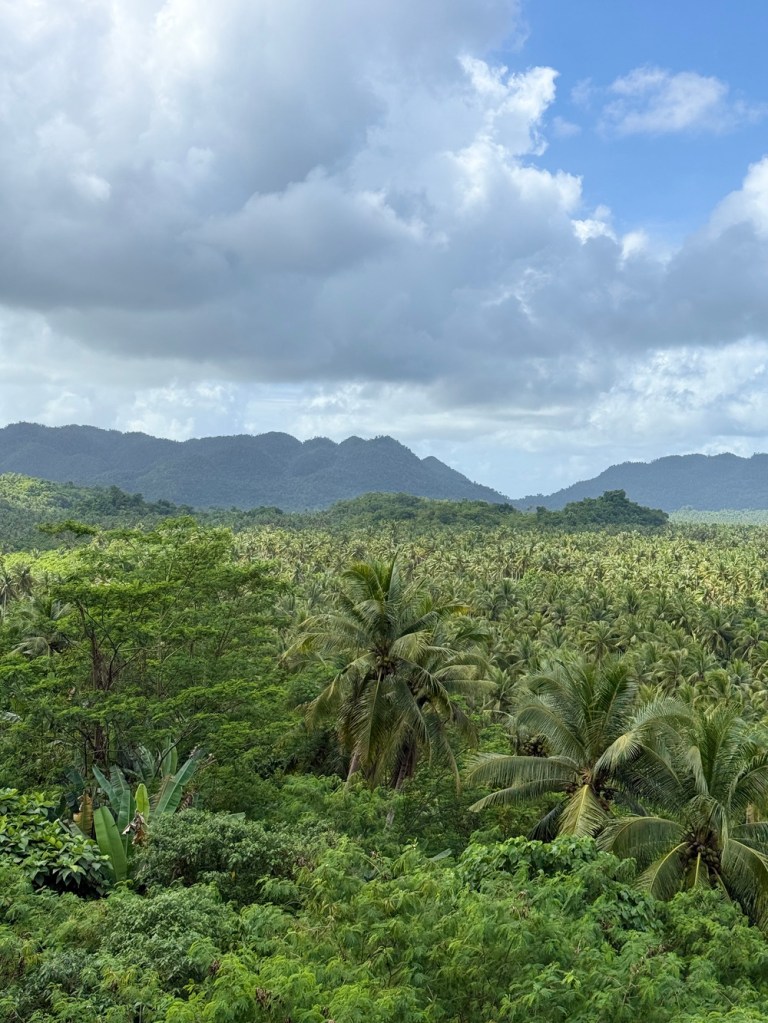
Landscape and Island Tranquility
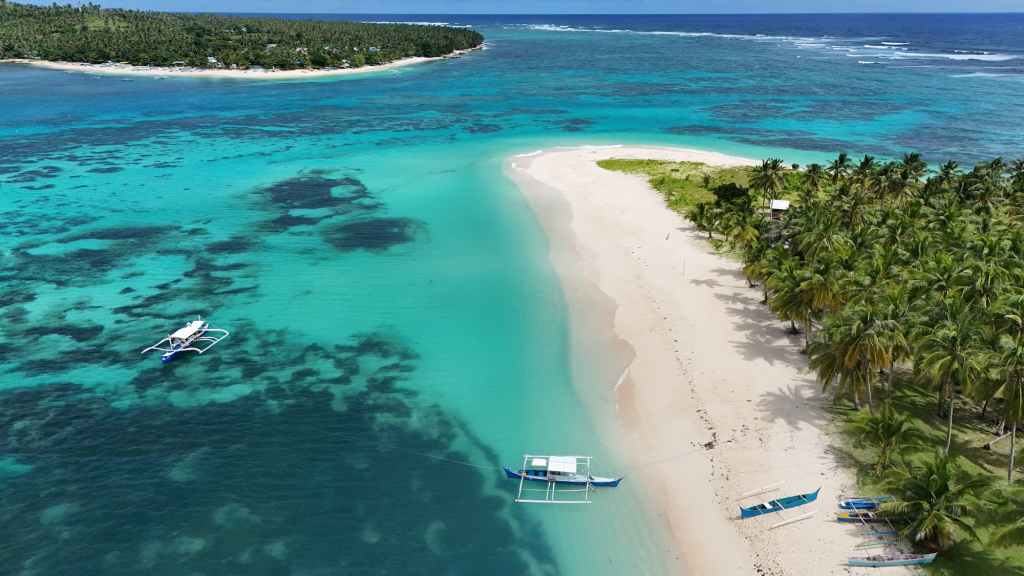
One of the most incredible things you can do in Siargao is ironically…. leaving Siargao for the day. The most beautiful place we visited in the Philippines was an hour away from Siargao by bangka– a precarious and noisy artisanal wooden boat to get to an island named ‘Mam-On’. Most online blogs don’t mention this island as it’s harder to get to, but it was so worth it. Our boat was old and rickety but did the job and weathered rougher sea conditions on the return journey well.
Mam-On isn’t offered in any of the main tours via GetYourGuide, Viator etc which instead offer trips to the closer touristy islands of Daku, Naked Island, and Guyam, so you will have to do some homework to pay a visit to this earthly paradise. We only managed to find one tour company via Instagram prepared to take us there, for a whopping price of 300 euros!
Instead, you can skip all this nonsense and go directly to the General Luna Tourism Office located at the port which offer much lower prices. We paid 100 euros for 2 for a private tour which included Guyam, Daku, Naked Island and finally Mam-On. The price covers admission fee, tour guide fee and docking fee. The tour guide is not optional, and not needed. The most useful thing our guide did was tell us at 4PM when we needed to turn back.
With it being a private tour, you can customize the tour and choose how long to spend on each island provided you start your journey back at 4PM as per coastguard rules which provides flexibility and freedom as opposed to group tours. You can also leave as early as you want to in the morning which is great to maximise time. We decided to do the islands in reverse and go to Mam-On first as it was the furthest away, and chose to spend the majority of our time there as it was just so beautiful (see pictures below). Due to the amount of time we spent there and because of weather conditions, we managed to only visit Mam-On and Daku which we were more than happy with.
Before leaving the port in the morning, we bought food in the local market which the locals of Mam–On island later cooked for us. As we approached the island we were blown away by its natural beauty and untouched nature. Upon arriving at Mam–On we received an itemised bill for more fees despite paying 6,500PHP earlier at the tourism office. These included yet another environmental fee, a cooking fee and ingredients fee (for salt/soy cooking our food). It’s fair enough but these charges weren’t explained up front at the tourism office which is sneaky and untransparent.
We were incredibly fortunate with sunny weather on the island itself which was a paradise with only locals living there adorned by a small school for the island’s children. The waters are pristine and turquoise to swim and snorkel in, there are lush green coconut trees to explore and the largest conch shells we’ve ever seen.
When leaving Mam-On we encountered some stormy weather but navigated it fine. Our final destination was Daku which was slightly larger with more housing but with unspoilt sandy beaches perfect for volleyball with a basketball court also existing alongside more incredible and beautiful friendly locals.
Surfing in Siargao – The Largest Attraction
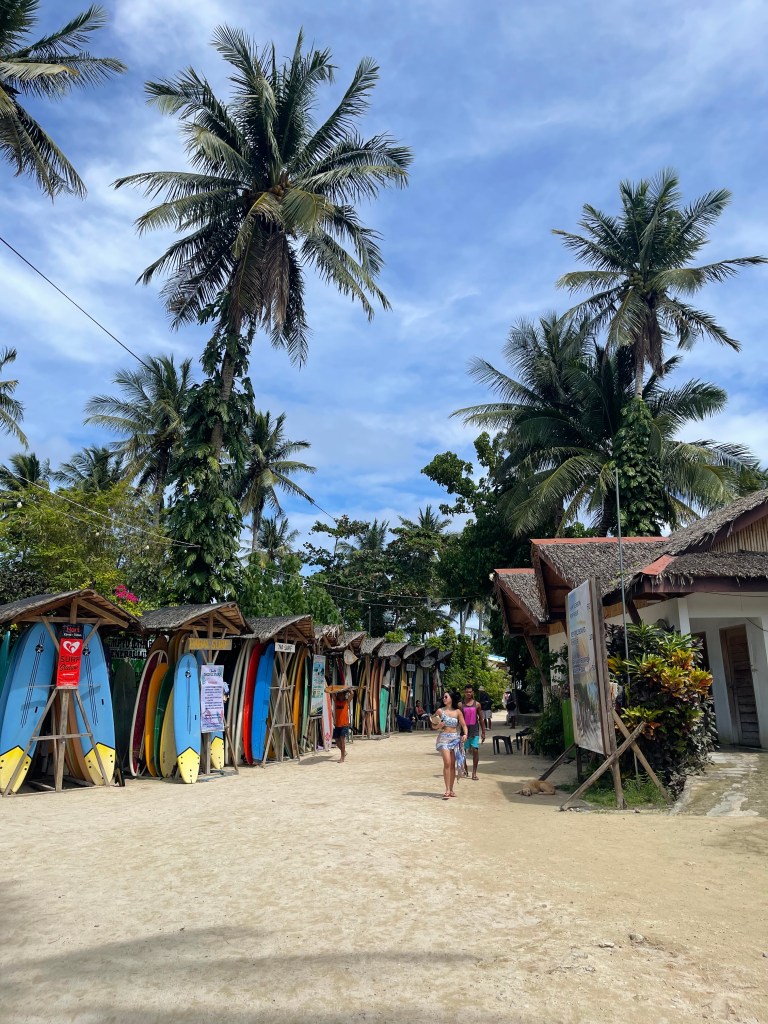
Siargao has different districts known as “poblaciones”. General Luna is the main poblacion and is where the proclaimed surfing capital resides at Cloud 9 beach.
To enter the beach there is a fee of 100PHP per person any time you visit even if you don’t surf and just want to relax. When arriving at the beach we experienced ‘hustle culture’, being greeted by locals impatiently trying to sell surfing before we’d even jumped off the Tuk-tuk.
If you’re a beginner, lessons can be had for 600PHP per person. Our instructor wasn’t great and didn’t encourage us to practice popups on the beach beforehand like most surf lessons and instead took us straight to the intermediate spot. This was a mistake. In comparison to great surfing tuition we previously had in SE Asia, this experience felt impatient with insufficient English spoken and a lack of guidance overall. If you’re with a partner or friend it would be better to rent a surfboard and help each other in the waves instead. Also cheaper. The instructor flirting with your girlfriend is free of charge however.
Perhaps for an experienced surfer it offers the smoothest and well barrelled waves, but being a reef point it’s still rocky / dangerous and not well placed for beginners despite what you read online. We believe the reputation of this part of the island is overhyped and isn’t worth the cost for non experienced surfers.
After visiting Cloud 9 to get a quick ride home, one option is via the Tuktuk mafia who wait outside the beach. This is the only part of the island where prices fluctuate and seem to be exploitative rather than fixed. We met some super lovely Tuktuk drivers on this trip; genuinely kind souls, but the ones at Cloud 9 were a different breed.
Food
The influence of the past colonization by Spain and the US has left a mark on this country’s cuisine. Their traditional recipes tend to be centered around staple ingredients, with rice being a key component in most dishes. Flour and cheap snacks are enriched to address the population’s malnutrition. You can easily find local fast food tailored to Filipino tastes. Fresh vegetables seem to be harder to come by in rural areas. We noticed that only high-end tourist restaurants offered this.
One of the unique things here is the “boodle fight” which is a meal option offered on shared tours. It is a Filipino communal dining tradition where a large feast consisting of rice, meat, seafood, and vegetables is shared with bare hands directly from a table covered with banana leaves. We didn’t choose this option and even that wasn’t enough to avoid a gut infection leaving one of us seriously ill for 3 days in our hotel room.
As a tropical country, Siargao offers tasty, colorful and naturally sweet fruit (simply delicious!). Throughout the Philippines, you can find something truly special: calamansi. This small citrus with its unique blend of lime and mandarin flavors is used to enhance fish dishes or enjoyed as a natural juice with a bit of honey containing a number of health benefits.
We have a passion for traditional food, and it is a crucial part of every trip, however we on this trip we weren’t brave enough to try balut (a fertilized and boiled duck egg) which you can also find in other Asian countries like Vietnam.

Weather
We visited the island in February. When we did our research about what to expect in terms of weather and temperature, we noticed it would be more or less the wet season which usually runs from October to March. We accepted we would experience occasional rainfalls. However, climate change is now aggressively enhancing this making the weather much more unpredictable.
We experienced 1.5 days of sunshine in our 8 day stay, the rest being mostly heavy rain. It’s not spoken about enough that this kind of weather isn’t good for surfing and can in fact be highly dangerous. Other than a handful of activities like pickleball there aren’t many indoor activities available on the island in this kind of weather. Cafes aren’t well equipped enough to welcome people for a longer-than-breakfast stay and the internet is poor – unreliable and inconsistent, contrary to what many blogs will tell you. We would not want to remote work here. This is a consistent theme in the Philippines however, and not exclusive to Siargao.
Despite being wet season, General Luna was incredibly busy; we couldn’t imagine how it would be in the dry season with more tourists; likely unbearable.
Environmental Concerns
Greenwashing is everywhere these days and Siargao is no exception. It applies the worst side of marketing – promotion without substance. The claim to be a “plastic free” island is fabricated. While glass or carton straws are used in many places and water filters are offered in some cafes (which we commend), many shops still sell plastic products and use of plastic straws in restaurants is abundant. As soon as you walk outside General Luna’s main ‘Tourism Road’ – you see locals living in their traditional houses, throwing plastic bags and residuals in designated areas where the traces of fires are still visible, evidently releasing these toxic chemicals making it clear that despite the environmental fees the government collects, little of it is being used to improve these conditions.
Airport and Infrastructure
Infrastructure is the litmus test of a country’s management. Siargao has one main road connecting its poblaciones to its undersized international airport.
IAO airport is just too small, having only 2 operating gates and many flights scheduled at the same time which just creates chaos due to the small and heavily congested space which is now over capacity for the amount of tourists it receives. This leaves people sitting on dirty floors and in random spots. Proper meals aren’t available inside and bottled water is overpriced.
Something common on the island we found was bathroom drains have failed in many places possibly due to flooding as you can easily find cafes decorated with funny signs declaring “no poo toilet” rendering them only partially usable.

Conclusion
Siargao is pitched as an island haven for surfers, but in reality we found it to be more a tourism trap and a spot for westerners to set up boutique shops selling hemp candles alongside overpriced restaurants that have service charges similar to Europe. This allows the westerners who emigrate here to live to profiteer from this rising culture of surf tourism as a result of being perpetually promoted by social media.
Having seen the struggles of the locals (our lovely regular Tuktuk driver being one of them) it’s hard to think what life would be like without the income of tourism. However, at the same time, Siargao is being developed at an unprecedented rate because of this social media obsession and claiming more and more of their land. This has resulted in construction appearing everywhere all day, every day. When we needed to stay in the hotel for 2 days due to being ill, all we heard was drilling and chainsaws in every direction.
The island is marketed as one of the Philippines best. If this isn’t your first time in the Philippines, you could be disappointed. In comparison to other islands like Palawan Siargao doesn’t appear anywhere near organised enough for the level of tourists it receives.
Some nations apply policies to protect their country from massive tourism. The fees that have been normalized here could be interpreted as such a policy but they are evidently not a deterrent. The rest of Siargao seems to offer an authentic tropical experience despite not having much time left to visit it. However it doesn’t feel special enough compared to other parts of the Philippines. We left with the feeling of constantly paying into a black hole with no transparency of where our money was being spent.
To conclude, the price:benefit ratio to experience this island wasn’t worth it for us in comparison to other Philippine islands and other SEA nations offering similar experiences for surfing and beaches.

Leave a comment